VISITOR GUIDE · 2026-10-19
Knee Pain Care in Korea: A Visitor’s Assessment Checklist
Knee pain can affect much more than a planned activity: subway stairs, airport queues and hotel access may all become relevant. Use an appointment to clarify the problem and make a workable plan rather than selecting treatment solely from a procedure list.
In this guide
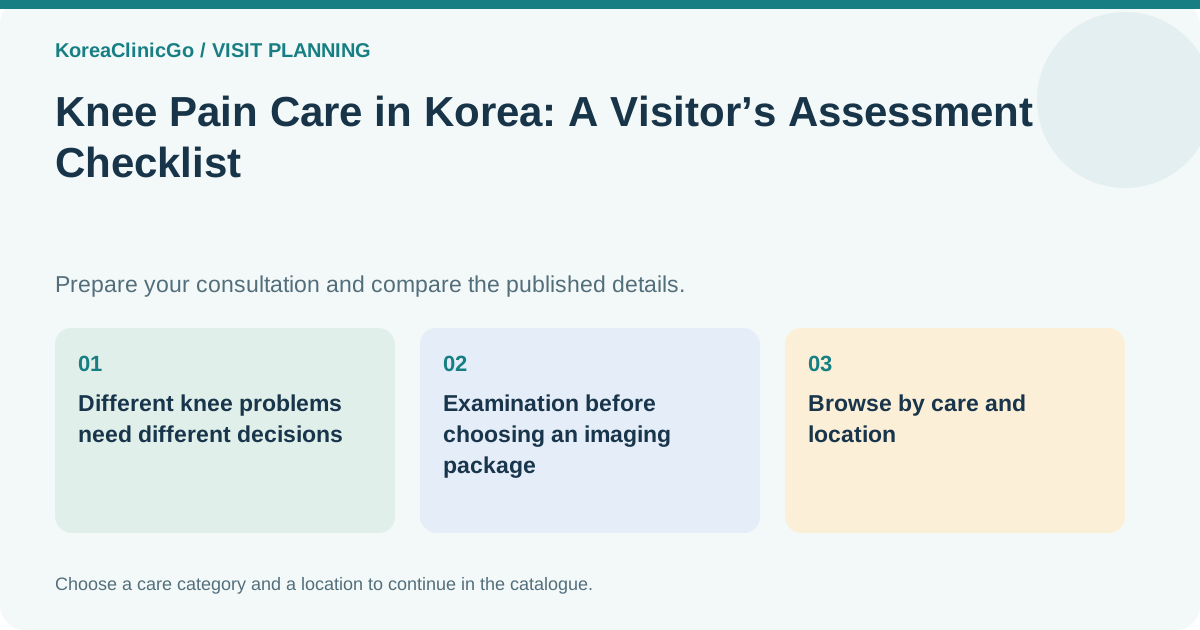
- Different knee problems need different decisions
- Examination before choosing an imaging package
- When osteoarthritis is confirmed
- Explain how the problem began
- Show the effect on ordinary travel
- Budget for the type of pathway proposed
- Compare complete care plans rather than a single fee
- Plan mobility rather than just the clinic visit
- Know when to seek urgent assessment
Different knee problems need different decisions

Knee pain can arise after a twist or collision, from repetitive loading, or without a clear injury. Osteoarthritis is one possible explanation for ongoing pain and stiffness, but it is not the diagnosis of every painful knee.
Locking, swelling or giving way are useful descriptions for an examiner, not a reliable way for a visitor to identify a particular ligament or cartilage injury. The clinical question also changes between a recently injured knee and a longstanding problem with worsening everyday function. Keep those histories separate when reading procedure pages or comparing services in a catalogue.
Examination before choosing an imaging package
A medical or musculoskeletal assessment establishes what needs investigation. Orthopaedic services may be relevant to structural injury or surgical questions; rehabilitation can address function when the assessment supports that approach. Imaging should answer a clinical question rather than serve as a required purchase for every painful knee.
Prior images can be useful, but the date and symptoms at that time matter. A request describing inability to walk normally is more informative than a preselected request for an MRI. The clinician can then explain whether examination, imaging or another assessment is the appropriate next step.
When osteoarthritis is confirmed
NHS guidance describes exercise, symptom-relieving medicines and supportive therapies as important options for osteoarthritis. The programme is individualized; doing unsuitable exercise too quickly is not equivalent to supervised rehabilitation. Some people may be offered an injection when other approaches have not helped, but temporary symptom relief does not mean cartilage has been restored.
Joint surgery is considered for selected circumstances when other care has been insufficient or daily life is substantially affected. Surgery also cannot guarantee complete freedom from pain or stiffness. These limits matter when a visitor is comparing a one-session offer with a longer clinical pathway.
Explain how the problem began
Tell the clinician whether the pain followed a twist, collision, exercise session or no obvious event. Record the date, the location around the knee and whether symptoms have changed since then. Describe swelling, locking or giving way in your own words without trying to assign a ligament or cartilage diagnosis. If both knees are affected, explain whether they behave differently. Include what happened immediately after an injury, such as whether you continued walking, because the sequence may be difficult to reconstruct once the trip becomes busy.
Show the effect on ordinary travel
Prepare examples from your current day rather than a pain score alone. Can you manage a station staircase, get out of a low seat or stand while waiting for transport? Explain which distances or positions are difficult and whether you are using a support or mobility aid. Ask the clinic about step-free access before arrival if you need it. A convenient area on a map is not necessarily convenient when the building entrance or transfers require several flights of stairs.
Browse Seoul clinics on KoreaClinicGo → · Browse Busan clinics on KoreaClinicGo →
Budget for the type of pathway proposed
A knee assessment, an injection and a joint operation have very different cost structures. A written estimate should distinguish examination, imaging interpretation, procedure fees, supports and rehabilitation. If surgery is proposed, it should also describe the setting, any admission and planned reviews. Equipment may have its own purchase or rental terms.
A rehabilitation course should state whether the first assessment counts as a session. This breakdown allows a fairer comparison than headline prices that may refer to different diagnoses, appointment lengths or stages of care, and it avoids treating unconfirmed optional services as unavoidable costs.
Compare complete care plans rather than a single fee
Request an estimate that separates the consultation, investigations, any procedure, rehabilitation and follow-up. Ask whether support equipment is included, rented or purchased separately. If treatment involves several appointments, write their dates beside your departure date before committing to a package. Discuss who will review an investigation that becomes available after you leave. For insurance reimbursement, ask which diagnosis description, invoice and payment receipt can be issued, while confirming coverage with the insurer rather than relying on a clinic's general statement.
Plan mobility rather than just the clinic visit
Consider the entire day around an appointment: distance from vehicle drop-off, hotel steps, low seating and station transfers. A visitor who expects to walk extensively may need an itinerary adjustment even when treatment is outpatient. For any proposed intervention, define which functional task will be reassessed and who will do it.
A timetable stating only the procedure day leaves a gap if swelling, pain or walking ability needs review later. If onward care is required, the handover should explain both the clinical findings and the current level of mobility so the next provider can continue from the same point.
Know when to seek urgent assessment
NHS guidance advises urgent assessment for a knee that is extremely painful, cannot bear weight, is badly swollen or deformed, or is hot and red with a high temperature. These situations should not wait for routine trip planning. After a non-urgent visit, request an explicit plan for walking and other activities, the point at which progress should be reassessed, and the route for contacting the treating team. Carry both the clinical report and the imaging files onward so that your next clinician can review the same evidence.
Continue planning
Sources and editorial scope
KoreaClinicGo editorial team · Updated 2026-10-19. General information and visit planning.
Read the sources
Medical references support general understanding. They do not provide an individual diagnosis or treatment plan, or confirm a Korean clinic’s services.
Continue exploring with KoreaClinicGo
Use KoreaClinicGo.com to explore general and specialist clinics in the region you plan to visit. Read the published services and branch details, then narrow your options at your own pace.
Browse general and specialist clinics →
This guide does not rank or recommend individual hospitals. Confirm current opening status and appointment availability with the exact branch before travelling.