VISITOR GUIDE · 2026-10-19
Alopecia areata in Korea: preparing for patchy hair-loss assessment
Sudden patches of hair loss can make a traveller anxious to act quickly. In Korea, begin with a medical hair and scalp assessment that clarifies the cause and how follow-up would work after your visit.
In this guide
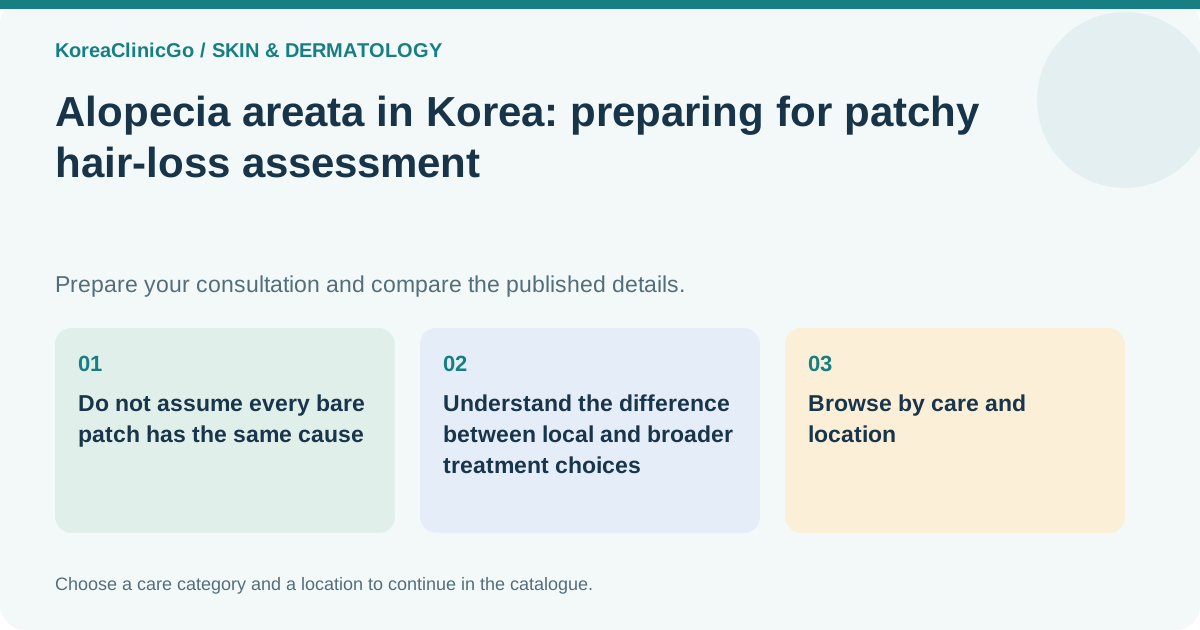
- Do not assume every bare patch has the same cause
- Understand the difference between local and broader treatment choices
- Separate the early review from a regrowth judgement
- Compare an examination-led plan with a procedure bundle
- Preserve a useful second-opinion question
- Document the change without daily guesswork
- Book a condition-focused appointment
- Understand the rationale for any proposed treatment
- Price the follow-up commitment
- Leave with information your next doctor can use
- What should I request from a second-opinion hair-loss consultation?
Do not assume every bare patch has the same cause

Alopecia areata is an autoimmune condition in which hair loss can affect the scalp or other hair-bearing areas. Its course varies, and treatment choices depend on the person and pattern of loss. The NIAMS alopecia areata overview explains the condition and the role of clinical evaluation. It does not establish the cause of an individual patch from a photograph, so ask for confirmation before purchasing a regrowth package.
Understand the difference between local and broader treatment choices
Alopecia areata management depends on the pattern, extent, age and other clinical considerations. The AAD describes medicines applied to the skin, injections and systemic options for selected patients, with monitoring relevant to some approaches. AAD alopecia areata treatment provides an overview.
An isolated patch and more extensive loss should not automatically receive the same commercial package. Nor should a general scalp-stimulation service be assumed equivalent to treatment for the diagnosed condition. The medical discussion should explain the intended goal, alternatives and review criteria without promising regrowth or specifying a prescription through a catalogue.
Separate the early review from a regrowth judgement
The first follow-up can be about diagnosis, tolerance or a changing pattern, while evaluation of hair growth may need a different window. Record the clinician's proposed dates and the purpose of each review. Do not use an immediate post-procedure photograph as evidence that a regrowth plan has worked.
Keep scalp photographs consistent in view, lighting and hair position so that later discussion has a useful baseline. If the diagnosis or pattern changes, the next decision may be reassessment rather than simply purchasing more of the same sessions. A defined review question is more useful than indefinite weekly progress messages.
Compare an examination-led plan with a procedure bundle
Request separate subtotals for medical assessment, clinically proposed investigations, medicine or injections and repeat review. For an injection quotation, clarify the exact site or sites and whether the price applies to a patch, the whole scalp or one appointment. Record monitoring and prescriptions that would be needed after Korea.
A series of scalp services may be priced by visit while a medicine-led plan is priced by supply and review; dividing both by session count does not produce a meaningful comparison. Keep elective cosmetic services outside the medical subtotal until their specific role has been explained.
Preserve a useful second-opinion question
When two doctors differ, write down the actual difference: whether the diagnosis is uncertain, whether the extent warrants a different category of treatment or whether the follow-up arrangement is impractical. Bring that question, earlier records and your travel dates to the next consultation.
Avoid asking a new provider only whether a branded package is good. A clear question can lead to a reasoned plan even if no procedure happens that day. It also helps your usual clinician at home understand why a change was considered, what was agreed and which decisions remain open after the visit ends.
Document the change without daily guesswork
Bring photographs that show when the patch first became noticeable and how its size or distribution changed. Note whether eyebrows, eyelashes or other areas are involved. Record previous episodes, relevant health history and any medicines or supplements. If a doctor has already assessed you, bring that summary and test results rather than assuming the new clinic can access them. Consistent photographs help communicate the timeline more clearly than images taken under different bright lighting every day.
Browse Seoul clinics on KoreaClinicGo → · Browse Busan clinics on KoreaClinicGo →
Book a condition-focused appointment
Ask whether the clinic evaluates medical hair-loss disorders, not only elective transplantation or cosmetic scalp services. Confirm that a doctor will examine the scalp and whether interpretation is available for discussing uncertainty and treatment choices. Explain if you already have a diagnosis and are seeking a second opinion. A scalp-camera service may provide images, but ask what clinical assessment and written explanation are included rather than equating equipment with a diagnosis.
Understand the rationale for any proposed treatment
Ask which options the clinician considers appropriate, what the intended goal is and what review would determine the next step. Discuss whether a test would meaningfully change management. Ask about monitoring requirements and whether the proposed treatment is practical to continue with a doctor at home. Avoid treating a menu of injections or light treatments as a universal protocol; your history and examination should drive the conversation, and no outcome should be guaranteed.
Price the follow-up commitment
Get separate charges for consultation, scalp examination, any sampling or laboratory work, medicines and repeat procedures. Clarify whether a published amount applies to one patch, the entire scalp or a single visit. If regular appointments are recommended, estimate the full cost and travel requirement before prepaying. Ask what happens to unused visits and whether written records can be shared with the clinician who will supervise the plan after Korea.
Leave with information your next doctor can use
Request the working diagnosis, affected sites, findings, test results and any treatment details in the visit summary. Agree a review date and ask what changes need assessment sooner. If treatment continues abroad, identify the clinician responsible for prescriptions and monitoring instead of relying on informal messages alone. Keep administrative receipts separate from medical instructions, so that the information needed for continuity is easy to find when you return home.
What should I request from a second-opinion hair-loss consultation?
Ask for the clinician’s assessment, the findings supporting it and what they would change or leave unchanged. Bring earlier records so the visit can address the actual question without unnecessarily repeating the entire work-up.
Continue planning
Sources and editorial scope
KoreaClinicGo editorial team · Updated 2026-10-19. General information and visit planning.
Read the sources
Medical references support general understanding. They do not provide an individual diagnosis or treatment plan, or confirm a Korean clinic’s services.
Continue exploring with KoreaClinicGo
Use KoreaClinicGo.com to explore skin clinics in the region you plan to visit. Read the published services and branch details, then narrow your options at your own pace.
This guide does not rank or recommend individual hospitals. Confirm current opening status and appointment availability with the exact branch before travelling.