VISITOR GUIDE · 2026-10-19
Sleep Apnea Assessment in Korea: Study Planning and Follow-Up
An overnight appointment can look simple on a travel calendar, but a useful sleep assessment needs preparation, interpretation and onward care. Clarify whether you need a first investigation or review of an established sleep condition before choosing a study slot.
In this guide
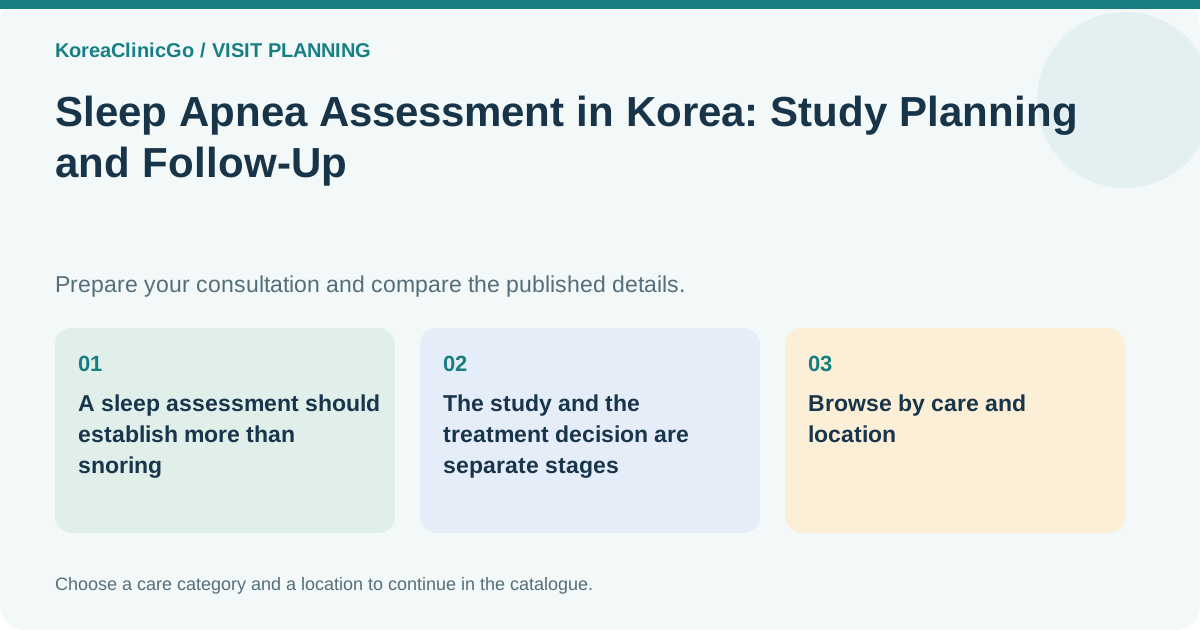
- A sleep assessment should establish more than snoring
- The study and the treatment decision are separate stages
- PAP, oral devices and selected procedures
- Record sleep and daytime function
- Bring earlier studies and device details
- Identify the full testing and equipment bill
- Allow time for interpretation and the next decision
- Plan for a result that may lead to another appointment
- Leave with an accountable handover
A sleep assessment should establish more than snoring

Snoring, observed pauses and daytime sleepiness are useful observations, but they do not establish the type or severity of a sleep disorder. NHLBI describes a history and sleep study as parts of assessment for sleep apnea. The report needs clinical interpretation, not only a count or an app-generated score.
A visitor already using treatment may instead need review of an earlier study or difficulty with a device. Those are different appointment purposes. Recording the existing diagnosis, device and reason for review helps the team avoid treating every request as a first-time overnight screening visit.
The study and the treatment decision are separate stages
A consultation should explain which study is proposed, what it records and which question it can answer. When a result is available, the professional needs to connect it with symptoms and relevant medical history. If the study suggests further assessment, that next stage needs to be scheduled or handed over explicitly.
An overnight booking alone is not a complete clinical pathway. For a visitor with an existing report, reviewing that document may be more relevant than immediately repeating it. Test selection and the plan for interpretation should be settled before assuming that a single night in a centre will resolve the whole concern.
PAP, oral devices and selected procedures
NHLBI describes positive airway pressure as a common treatment, with different device types considered for different needs. An oral appliance is another option in selected circumstances and requires appropriate fitting. Surgical approaches address particular problems and are not suitable simply because a person dislikes one mask.
Lifestyle measures can form part of the plan, but their role should be individualized. A device is useful only with instructions and a route for dealing with fit or tolerance problems. Treatment choices therefore include practical continuing support as well as the initial equipment or procedure; they should not be reduced to a ranking of newest technology.
Record sleep and daytime function
Note typical bedtimes, waking times, interrupted sleep and daytime alertness. If someone has observed breathing pauses or unusual sleep behaviour, describe their observations separately from your own experience. NHLBI explains that a sleep diary and symptom discussion can support assessment. Include recent travel so the clinician can consider your sleep pattern in context. Do not treat a phone recording or wearable score as a confirmed diagnosis. A diary that distinguishes workdays, flight days and ordinary nights is easier to explain than a single average produced by an app.
Bring earlier studies and device details
If assessed before, request the complete study report and interpretation rather than one summary number. Include the date, treatment plan and subsequent reviews. If you use a breathing device, take its model, prescribed settings and available reports, asking which data format the receiving service can review. List relevant medicines and health conditions. Do not change settings or stop prescribed treatment to create a different test result; preparation should be directed by the clinician arranging assessment. Keep original device reports alongside any personal summary.
Browse Seoul clinics on KoreaClinicGo → · Browse Busan clinics on KoreaClinicGo →
Identify the full testing and equipment bill
A study quote should state whether consultation, interpretation and result discussion are included. If equipment is recommended, the purchase or rental terms, mask and accessories, fitting appointment and later support need to be identified. Device servicing and replacement supplies may involve another provider after departure.
A surgical pathway requires a separate estimate and discussion of follow-up. Comparing only the price of an overnight test with a package including equipment can obscure these differences. The insurer may also require the study and clinician's interpretation before authorizing equipment, so confirm its sequence rather than assuming reimbursement after purchase.
Allow time for interpretation and the next decision
Ask when the report will be ready and how it will be discussed. Do not assume every decision will be completed the morning after a test. If treatment or equipment is proposed, discuss fitting, reviews, supplies and support after leaving Korea. Ask whether your usual clinician can take over and which records they need. Obtain separate costs for consultation, study, interpretation, equipment and follow-up. Confirm insurer authorization rules before purchasing a package, including whether an initial assessment must happen before testing is approved.
Plan for a result that may lead to another appointment
An international visitor should reserve time for explanation of the result instead of booking the study immediately before a flight on the assumption that everything will be finalized at checkout. If treatment is prescribed, the receiving professional at home needs the study, interpretation and details of the chosen plan.
If equipment was already in use, preserve old settings and the clinician's documented changes so they are not confused. A successful short visit may mean a clearer diagnosis and coordinated handover; it should not be judged only by whether a device or procedure was obtained before departure.
Leave with an accountable handover
Request findings, an explanation and the next step in writing. Ask what remains uncertain and whether further assessment is needed. If continuing care at home, identify who will review progress and device-related questions. Keep the original report with a translation instead of replacing it with a short travel summary. When exploring the catalogue, select a general care category and location, then confirm the appropriate sleep pathway directly. A listing alone does not verify testing arrangements, report timing, device support or the language available on a particular date.
Continue planning
Sources and editorial scope
KoreaClinicGo editorial team · Updated 2026-10-19. General information and visit planning.
Read the sources
Medical references support general understanding. They do not provide an individual diagnosis or treatment plan, or confirm a Korean clinic’s services.
Continue exploring with KoreaClinicGo
Use KoreaClinicGo.com to explore general and specialist clinics in the region you plan to visit. Read the published services and branch details, then narrow your options at your own pace.
Browse general and specialist clinics →
This guide does not rank or recommend individual hospitals. Confirm current opening status and appointment availability with the exact branch before travelling.